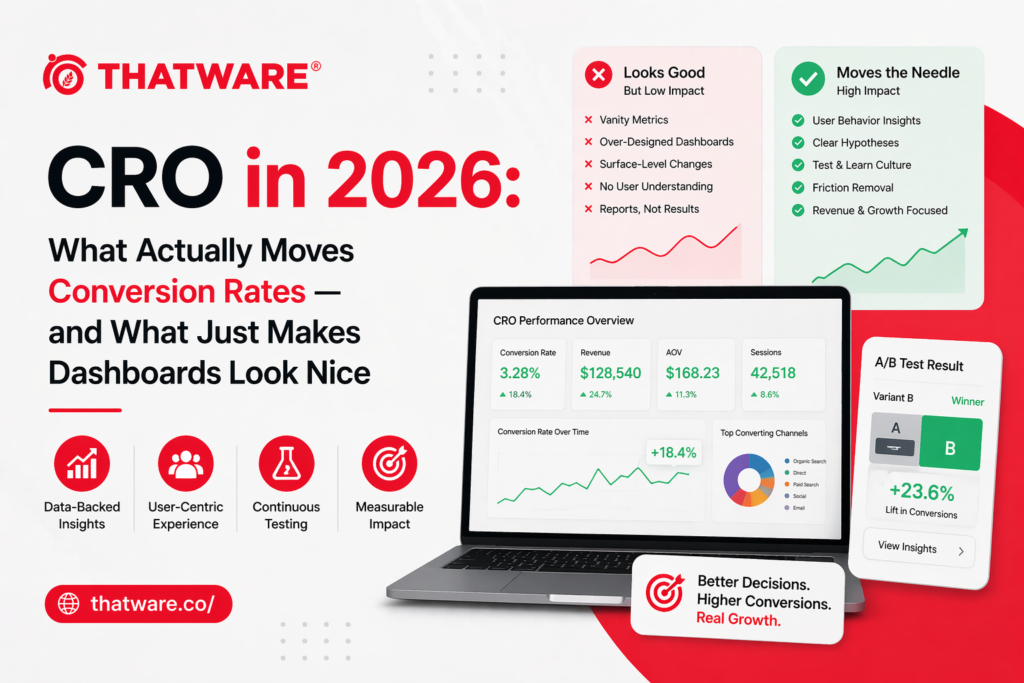
Conversion rate optimization has a bad reputation in some quarters, and it’s at least partially deserved. A lot of what’s been sold as CRO over the years is button color testing, headline tweaks, and statistical noise dressed up as insight. Dashboard numbers move, reports get produced, and actual conversion rates stay frustratingly flat.
The CRO that actually works in 2026 looks quite different from that. It’s more rigorous, more behavioral, more connected to actual user psychology – and considerably more impactful when done right.
Why Most CRO Programs Underdeliver
The failure mode of bad CRO is usually one of a few things. Testing too many things simultaneously without the statistical power to detect real effects. Running tests to completion based on arbitrary timelines rather than statistical significance. Treating individual test results as definitive rather than as signals in a longer learning process. Optimizing for micro-conversions that don’t actually predict revenue.
The more fundamental problem is treating CRO as a testing program rather than a user understanding program. A/B tests are a tool for validating hypotheses. If your hypotheses aren’t grounded in genuine understanding of why users aren’t converting – what’s creating friction, what’s creating doubt, what’s creating confusion – you’re testing random things and finding random effects.
What Actually Drives Conversion
User behavior research – session recordings, heatmaps, user interviews, on-site surveys – consistently reveals that conversion failures are not usually caused by the wrong button color. They’re caused by: unclear value propositions that don’t answer the user’s actual question about why they should care, trust gaps where users aren’t confident the brand will deliver what it’s promising, friction in the conversion process that creates unnecessary cognitive load or steps, and misalignment between the traffic source’s intent and the landing page’s content. Related context: 10 FAQs About Choosing the Right Tech Gadgets for Work.
cro services that address these root causes – through qualitative research that identifies actual failure points, followed by substantive page redesigns and copy improvements, validated through testing – produce meaningful conversion rate improvements. Testing surface-level elements without addressing these root causes produces incremental noise.
The Trust Architecture Problem
Trust is underemphasized in most CRO frameworks. Conversion is fundamentally a trust transaction – the user is deciding whether to give you their contact information, their money, or their time, based on how much they trust you’ll deliver what you’re promising.
Trust signals – reviews, testimonials, credentials, security indicators, recognizable brand elements, specific evidence of past performance – aren’t ornamental. They’re functional conversion elements. Pages that lack adequate trust architecture underconvert relative to their traffic quality, and no amount of headline testing will fix that.
Building the right trust architecture for a specific audience requires understanding what that audience specifically fears or doubts, and addressing those specific concerns with credible evidence. Generic “trusted by thousands of customers” language does less work than specific, concrete social proof that speaks to the actual concerns of the converting audience.
Mobile Conversion Reality
Mobile conversion rates are typically lower than desktop for most business categories. That gap is real and worth understanding – but it’s not fixed. The causes of mobile conversion underperformance are usually specific and addressable: forms that are poorly designed for mobile input, checkout flows that weren’t built with mobile UX in mind, content that requires pinching and zooming, load times that exceed mobile patience thresholds.
conversion rate optimization services in 2026 treat mobile CRO as a distinct discipline from desktop CRO. The user context is different – different intent patterns, different distraction levels, different cognitive mode. Optimization approaches that work on desktop don’t always translate, and testing that only measures aggregate conversion rate can miss divergent mobile performance.
The Statistical Validity Problem
Here’s an uncomfortable reality about most CRO programs: they don’t have enough traffic to run statistically valid tests on the timescales they’re running them. A page with 500 monthly visitors can’t produce a statistically significant A/B test result in a month. Running a test for two weeks and calling a winner based on that data is producing noise, not insight. Related context: Creative Science Project Ideas Using DC Motor for Students.
Low-traffic sites need different CRO approaches. Qualitative research methods – user interviews, usability testing, expert reviews – produce actionable insights without requiring statistical sample sizes. Larger changes tested over longer periods accumulate more signal. And being honest about the uncertainty in test results is more valuable than claiming confidence you don’t actually have.
What Good CRO Programs Look Like
The programs that consistently produce meaningful conversion improvements share a few characteristics. They invest in user research before they start testing – understanding why users aren’t converting before trying to fix it. They make substantive changes based on that research, not surface tweaks. They run tests with appropriate statistical rigor and patience. They connect CRO outcomes to revenue and pipeline, not just conversion rate as an isolated metric.
And they treat CRO as a continuous learning process rather than a project with an end date. User behavior changes. Competitive context changes. The audience evolves. CRO programs that maintain continuous research and optimization cycles produce compounding improvements. CRO programs that run a burst of testing and then stop find their gains eroding as the context shifts around them. Related context: Powering Innovation with Gear Motor and Bluetooth Module Integration.
The difference between a CRO program that makes dashboards look nice and one that actually moves business outcomes is usually the quality of the underlying user research and the willingness to make substantive changes based on what that research reveals.